Zimbabwe is moving to open part of Harare’s internationally recognised Monavale wetland for housing reportedly intended for Members of Parliament, while holding the presidency of the global convention responsible for wetland conservation.
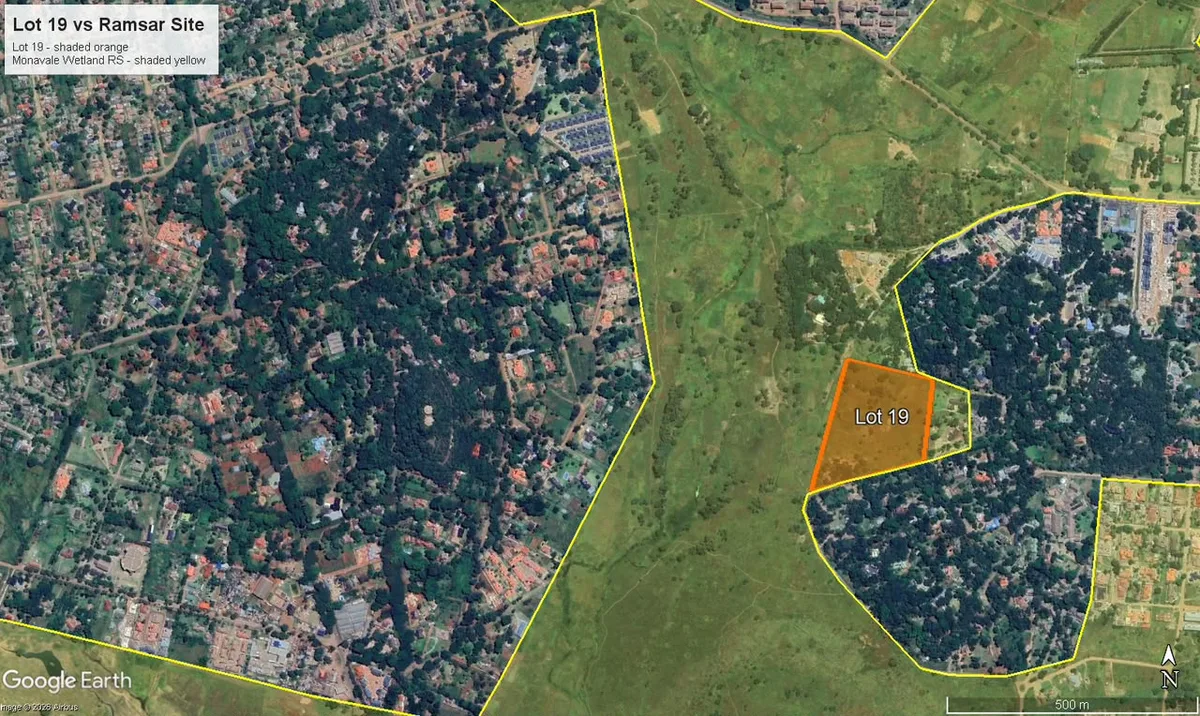
Local Government Minister Daniel Garwe has published a notice indicating his intention to consent to converting Lot 19, Monavale Township, from public open space and recreational use into 16 residential stands.
Lot 19, Monavale Township is a parcel of land located in the Monavale suburb of Harare, Zimbabwe.
Currently zoned as Public Open Space and Recreational under the Monavale West Section 1 Town Planning Scheme, the site forms part of the gazetted Monavale Wetland (also known as Monavale Vlei), an internationally protected Ramsar site.
“Under Zimbabwe’s presidency, our own Parliament is seeking to acquire and develop one of the country’s seven Ramsar-designated sites,” human-rights lawyer Doug Coltart told The Narrative Network.
“This situation risks undermining Zimbabwe’s credibility and environmental commitments under the Ramsar Convention.”
Zimbabwe assumed the Ramsar COP presidency from China at the COP15 summit in Victoria Falls in July 2025 and chairs the convention’s Standing Committee for the 2025–2028 period.
The country is scheduled to hand over the presidency to Panama at COP16, which will take place in Panama City from June 7–15, 2028.
Opening the Victoria Falls summit, President Emmerson Mnangagwa told delegates: “Wetlands are not wastelands. They are lifelines.”
The Monavale proposal would create stands averaging about 2,000 square metres each on land reserved as public open space under the Monavale West Section 1 Town Planning Scheme.
The notice, published on October 17, records Garwe’s intention to consent to changing the land’s reservation; it does not announce final approval for housebuilding.
Coltart, a partner at Mtetwa & Nyambirai Legal Practitioners, said the City of Harare had submitted the application and ministry officials had identified Parliament as the intended beneficiary.
“Following engagements with officials from the Ministry of Local Government, it has been established that this application is being made on behalf of the Parliament of Zimbabwe, which wishes to acquire this portion of Monavale for the development of MPs’ residential stands,” he said.
The proposal revives a dispute that prompted residents and environmental campaigners to confront earthmoving equipment earlier this year after land clearance began for housing reportedly intended for MPs.
Senior government officials subsequently ordered the work to stop, with the then Permanent Secretary Tafadzwa Muguti assuring residents that the protected area was “a no-go area”.
Energy Mutodi, the MP who led the legislators involved, accepted the intervention at the time.
“There is not going to be any development of any nature,” he said.
Coltart said the renewed application contradicted assurances given by senior officials, including Garwe and the environment minister.
“It was only through the intervention of ordinary citizens, including elderly women who stood in front of bulldozers to stop the unlawful activity, that the destruction was prevented,” he said.
An unsigned draft objection prepared for submission to the Provincial Planning Officer, seen by TNN, challenges the proposal on environmental, policy and public-interest grounds.
It says Lot 19 lies wholly within both the gazetted Monavale Ecologically Sensitive Area and the Monavale Ramsar site, arguing that subdivision, roads and housing would fragment habitat and damage the wetland’s ecological functions.
The document also questions how the proposed conversion fits the government’s own development commitments, citing wetland protection provisions in NDS2, the National Wetland Policy, the National Wetlands Management Guidelines and the National Human Settlements Policy.
It argues that approving residential development would contradict those commitments and the earlier undertaking to preserve the site.
Beyond the implications for Zimbabwe’s international standing, Monavale forms part of the Manyame catchment, which supplies Harare and surrounding communities, and is one of the country’s seven Ramsar sites.
“Wetlands are an essential part of the city’s water resources, and their destruction threatens the city’s environmental sustainability and water security,” Coltart said.