South Africa's Economic Freedom Fighters (EFF) has lost nearly four in every 10 votes it received in the previous municipal elections, raising questions about whether Julius Malema's party is experiencing a temporary setback or a deeper political decline.
The EFF secured 6.22% of the national vote in the Nov. 4 municipal elections, down from approximately 10.3% in 2021.
It also slipped from third to fourth place, overtaken by former President Jacob Zuma's uMkhonto weSizwe (MK) party, which secured 9.76%.
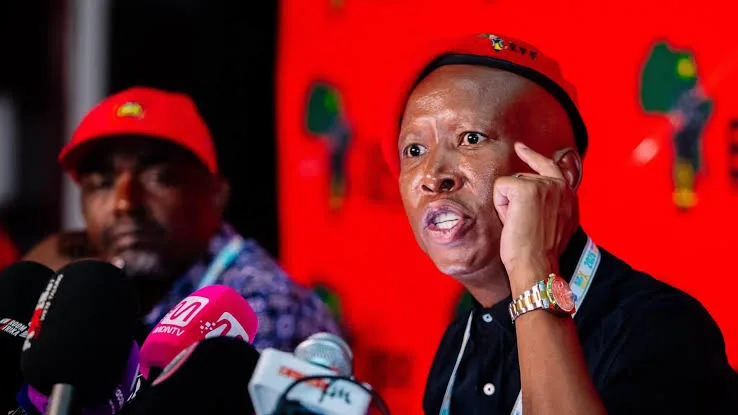
Malema acknowledged the losses during a Nov. 7 news conference in Midrand.
"We have lost 612,326 votes nationally and moved from third to fourth place," he said, referring to provisional figures.
The decline is significant for a party that entered South African politics in 2013 promising radical economic transformation.
In its first national election in 2014, the EFF won 6.35% of the vote and 25 parliamentary seats.
Support increased to 10.8% and 44 seats in 2019 before declining to 9.52% and 39 seats in 2024.
Municipal results reveal a similar pattern.
The party secured 8.24% in 2016, improved in 2021, and then suffered substantial losses this year.
Although national and municipal elections involve different voting patterns, both show that the EFF's earlier electoral expansion has stalled.
Is Malema's leadership becoming a liability?
Malema remains the EFF's most recognisable political figure. His confrontational approach helped establish the party as a voice for economically marginalised South Africans, particularly young people frustrated by unemployment and inequality.
However, concentrating political identity around one leader raises questions about institutional strength and succession.
The departures of prominent figures, including former deputy president Floyd Shivambu and advocate Dali Mpofu, exposed tensions within the party's leadership structure.
Their departures may have weakened organisational networks, although election results alone cannot establish how many votes the EFF lost because of them.
The challenge extends beyond Malema's personality.
Can the party develop enough credible leaders and functioning branches to maintain support independently of its founder?
Are its economic policies convincing voters?
The EFF advocates land expropriation without compensation, nationalisation of mines and banks, and greater state control over strategic economic sectors.
These proposals address South Africa's historical inequalities, but their implementation raises difficult questions.
Nationalisation requires substantial resources, capable public institutions and safeguards against corruption.
Land redistribution needs financing, infrastructure and secure arrangements that allow beneficiaries to produce economically.
The party's challenge is explaining how it would finance these measures, protect public resources and deliver measurable improvements.
For voters struggling with unemployment, unreliable water supplies and deteriorating municipal services, radical economic promises may carry less appeal without convincing implementation plans.
Nigerian political economist Claude Ake argued that African development must address people's material conditions rather than remain confined to political declarations.
His argument offers a useful test for the EFF: whether its political message connects with practical improvements in citizens' lives.
Has Zuma's MK party changed everything?
MK's emergence has transformed competition for voters dissatisfied with established political parties.
In the 2024 national elections, MK secured 14.58%, overtaking the EFF despite contesting its first general election.
Its 2026 municipal performance further established its presence, particularly in KwaZulu-Natal.
Both parties attract voters frustrated by inequality and the political establishment, but MK also draws strength from Zuma's political networks and regional support.
It is reasonable to examine whether MK has attracted former EFF supporters. However, the results cannot establish how many voters switched directly between the parties.
Some former EFF voters may have abstained or supported other organisations.
The MK factor is therefore important, but insufficient on its own to explain the decline.
Is a comeback possible?
Malema rejects the suggestion that the electoral losses represent political defeat.
"A setback is not a defeat," he said, promising to review the party's performance and how it communicates its service delivery message.
There are figures supporting a more complicated assessment.
Despite its national decline, the EFF increased its ward victories from 19 in 2021 to 37 in 2026.
This suggests that the party's organisational performance varies across constituencies.
However, gaining individual wards while losing hundreds of thousands of votes nationally highlights the difference between localised success and broader electoral appeal.
The EFF's recovery will depend on developments that remain uncertain: leadership stability, competition from MK, coalition politics, local governance performance and public confidence in its economic proposals.
Its performance in 2029 will provide another measure of whether the decline is temporary or structural.
For now, the electoral evidence reveals a party whose early momentum has weakened, even as pockets of local support remain.
Malema has acknowledged the problem.
The more difficult political question is whether the EFF's diagnosis of its losses will match what voters have been telling it at the ballot box.