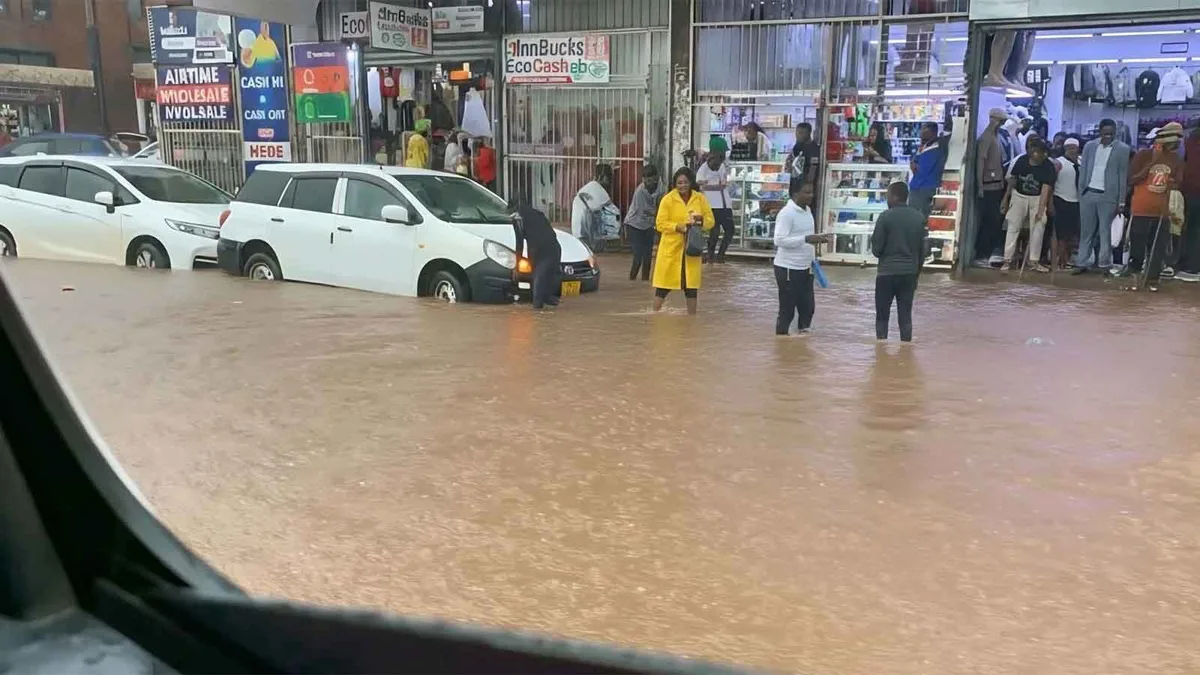
Businesses in central Harare are counting losses after Tuesday’s flash floods cut off customers, a year after the city council pledged to intensify efforts to clear blocked stormwater drains.
Several roads in the central business district (CBD) became impassable following heavy rains, with floodwaters entering some business premises and forcing traders to switch off electrical equipment for fear of electrocution and damage to appliances.
Nomsa Kangara, who operates a motor spares business in the city centre, said the recurrent flooding was undermining business operations.
She warned that if “the council keeps neglecting the drainage system, the problem will return every rainy season and we will keep suffering the same losses.”
The flooding also disrupted operations at a downtown grocery shop, where the owner was forced to switch off electrical appliances over safety concerns.
“Water entered my small grocery shop, and I switched off all electrical appliances, including fridges, because I feared electricity could harm us and damage the equipment in my shop,” the trader said.
A food outlet operator in the CBD expressed frustration over the deteriorating state of municipal services, saying businesses had yet to be informed when the drainage system would be repaired.
Contacted by The Narrative Network over whether the municipality had a concrete plan to rehabilitate the CBD’s drainage network and when the work would be completed, Harare Mayor Jacob Mafume initially responded: “I will see.”
After further attempts to obtain a substantive response, Mafume declined to comment, saying: “I am in China.”
Mafume’s response offered little clarity on the municipality’s plans to address a problem that has persisted despite repeated commitments to improve the city’s drainage infrastructure.
The latest flooding comes almost exactly a year after Mafume told an ordinary council meeting on November 20, 2025, that the municipality had intensified drainage clearance to minimise disruptions during the rainy season.
Two months later, following another bout of flooding, the council resolved to hire additional machinery to clear blocked stormwater drains.
At the time, the council’s health, disaster risk management and public safety committee chairperson, Jane Bhingari, expressed confidence that the intervention would curb flooding.
“We expect that by February, the city will not experience flash flooding even if we experience heavy rains,” Bhingari said in January.
She acknowledged that the municipality had insufficient machinery and raised concerns that lengthy procurement procedures could delay the exercise.
The extent to which the resolution was implemented remains unclear.
In its response to the latest flooding, the City of Harare attributed the phenomenon to exceptionally heavy rainfall, which overwhelmed the capital’s drainage systems.
“The flooding which has hit some parts of the City is a result of an extremely heavy and intense downpour,” council spokesperson Stanley Gama said.
The municipality also identified littering as a contributing factor, urging residents to refrain from dumping waste into stormwater drains.
However, concerns over the condition and maintenance of the drainage network predate the current rainy season.
In October, Combined Harare Residents Association (CHRA) director Reuben Akili warned that although the municipality had begun clearing some drains around June and July, debris extracted during the exercise was being left alongside the drains, where it risked being washed back into the system.
The association has previously attributed recurrent flooding to years of poor urban planning, corruption and neglect of drainage infrastructure, calling for rehabilitation and upgrading of the network.
Drainage rehabilitation has again been identified as a municipal priority in Harare’s proposed US$818.3 million budget for 2027.
Presenting the budget on October 29, Finance and Development Committee chairperson Jubilation Shoko said inadequate funding was constraining road rehabilitation and maintenance.
“The 2027 budget prioritises road rehabilitation, routine maintenance and improved drainage infrastructure,” Shoko said.
The municipality, however, has yet to provide TNN with a timetable for rehabilitating the CBD’s drainage network as businesses brace for heavier rains.