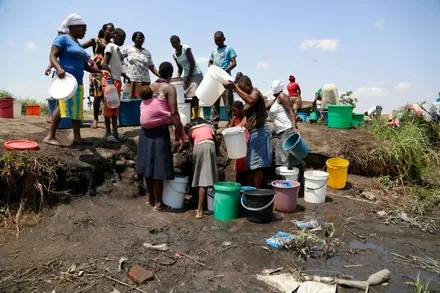
Harare residents face continued uncertainty over water supplies as the city struggles to secure up to US$2.7 million a month for treatment chemicals, with most of its revenue collected in local currency.
The financial pressure threatens to worsen the capital's longstanding water crisis, which has left some suburbs enduring prolonged supply interruptions despite ongoing efforts to improve water infrastructure.
Presenting the city's proposed 2027 budget at Town House on Oct. 29, Finance and Development Committee chairperson Jubilation Shoko said the municipality's dependence on local currency revenue was complicating the procurement of essential water treatment chemicals.
"The City's estimated monthly requirement of US$2.3 million to US$2.7 million for water treatment chemicals underscores the need for improved cash-flow management, reliable procurement funding and sustainable foreign currency financing mechanisms to safeguard water supply," Shoko said.
He said the council collects 80% of its revenue in Zimbabwe Gold (ZiG), while US dollars account for the remaining 20%.
The imbalance creates funding challenges for a municipality that requires a steady supply of foreign currency to purchase chemicals and maintain water treatment operations.
Although the Ministry of Finance has permitted the council to purchase foreign currency through the Reserve Bank of Zimbabwe, the municipality continues to face financial constraints.
Shoko said poor revenue collection was further undermining the council's ability to provide essential services.
"As at 30 September 2026, the City's average collection efficiency stood at 58%, a level that is inadequate to meet its operational and service delivery requirements," he said.
The figure means the municipality collected approximately US$58 for every US$100 billed, leaving a substantial gap between expected revenue and money available for operations.
The financial difficulties have raised questions about the city's ability to deliver on its proposed US$818.3 million budget for 2027, which allocates US$369.5 million to water, sanitation and hygiene services.
The allocation represents about 45% of the proposed budget, making water and sanitation the city's largest spending priority.
Meanwhile, the council's rollout of prepaid smart water meters has yet to resolve longstanding supply problems across the capital. Although the meters are intended to improve billing and revenue collection, their effectiveness depends on a reliable supply of treated water.
Financial constraints are also affecting other services, including road maintenance and rehabilitation.
Shoko said more than 40% of Harare's road network, covering over 2,000 kilometres, was in poor condition.
"The City must strengthen engagement with ZINARA, government and development partners to secure adequate funding. The 2027 budget prioritises road rehabilitation, routine maintenance and improved drainage infrastructure," he said.
Harare has struggled with water shortages for years because of ageing infrastructure, frequent equipment breakdowns and inadequate treatment capacity.
According to the city's water department, some sections of the water distribution network are more than 60 years old, while the infrastructure has not undergone a major capacity upgrade since 1994.
In April 2026, the council and private partner Helcraw Water began rehabilitating the Morton Jaffray Water Treatment Plant under a programme intended to increase water production and improve