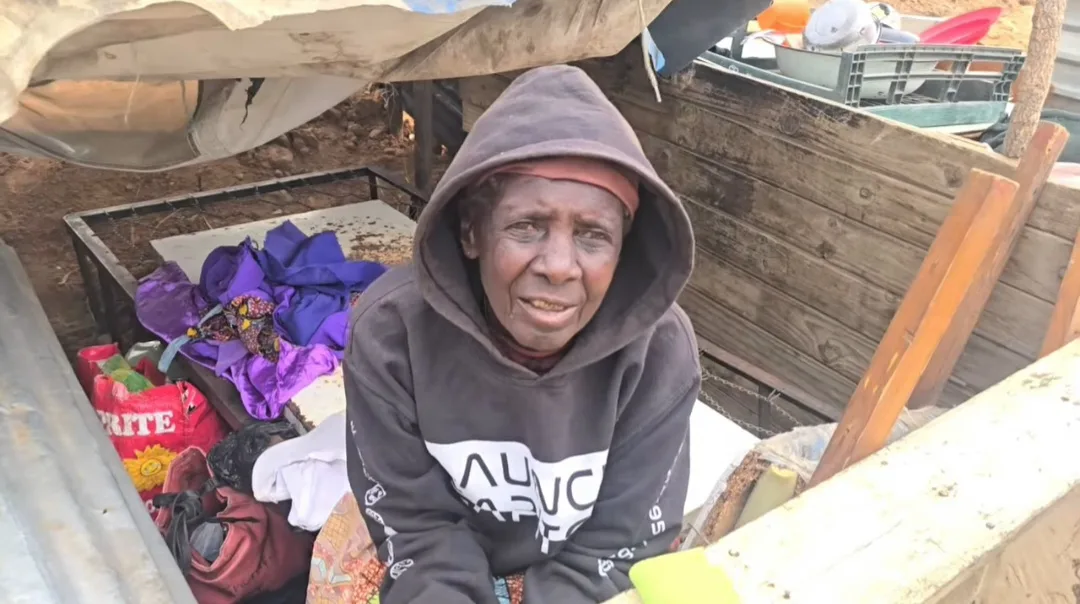
A few rocks hold down the rusting sheets of iron that serve as a roof.
On top sit a cooking pot, plates in a blue plastic crate and a green lid. Beneath the low roof, bedding is squeezed into a dark space barely resembling a room.
A large blue plastic drum stands on one side, with other household containers close by.
There are no proper walls, no solid doors and little to protect the occupants from the weather.
This is what passes for a home outside Warwick Farm, where families whose houses were demolished are now living in makeshift shelters along the roadside near Lake Chivero.
I stood looking at the structures, struggling to imagine what happens when the rain starts falling.
The pieces of iron, held in place by stones, offer some shade from the sun. But they are hardly protection against the heavy downpours that have already soaked the displaced families.
And this is not one isolated shelter.
As we travelled along the road, I saw one after another, built from plastic sheets, old roofing iron, wooden poles, sacks and whatever else people could find.
In some places, discarded household furniture had become part of the shelter itself.
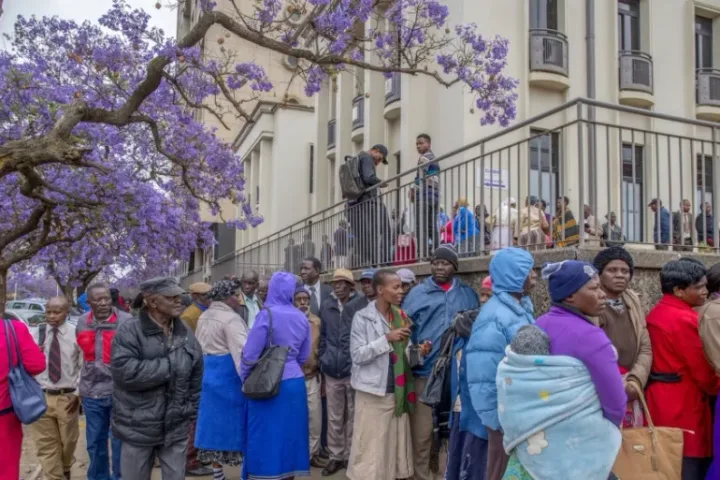
Women stood outside the structures. Children moved between them.
Clothes and household belongings lay exposed to the elements.
It was difficult to believe that these were the living conditions of people who, only recently, had houses they called home.
Warwick Farm is about 26 kilometres from central Harare, in Zvimba district, Mashonaland West province.
From Whitehouse along the Harare-Bulawayo Road, we turned left and travelled about nine kilometres, passing Rydale Ridge, a relatively new middle-density residential area.
As we approached the farm, the roadside began to tell its own story.
There were bags, blankets, broken furniture, clothes and children's schoolbooks scattered in the open.
Some people sat silently beside their belongings.
When The Narrative Network team approached them for interviews, they refused.
I did not insist.
There was something about their silence that said enough.
These were people who had lost their homes and were now struggling to find somewhere to lay their heads.
Perhaps telling strangers about their suffering was simply too much to ask.
Nearby, small boys and girls were laughing and chasing one another, seemingly unaware of the dangers around them.
The road is frequently used by heavy trucks carrying building sand, some of which residents say are in poor mechanical condition.
Yet the children continued playing, as children do.
I watched them for a while.
They were living beside a road, their families' belongings scattered nearby, but they still found reasons to laugh.
It was a painful contrast to the adults, whose faces showed the strain of trying to survive another day.
Among them were elderly people who had spent most of their lives at Warwick Farm.
Sekuru Rodgers Phiri, 81, has lived there since the 1960s.
He remembers the farm in the days of one Tim Johnson, the changes that followed and the land reform programme, during which parts of the property were allocated to war veterans.
Some of the beneficiaries, he said, subsequently sold their land to other settlers.
Then came Nicholas Nyandoro.
"Then came a guy called Nyandoro; he got land and stayed with us, but little did we know he was going to turn against us," Phiri told me.
"He eventually claimed that the land was his and we have been fighting him in the courts for a very long time. The matter is still before the courts, but surprisingly we have had our houses demolished, and we have been chased away."
Phiri's account reflects the residents' longstanding grievances over ownership of Warwick Farm, a dispute that has produced several court cases and judgments.
In July, the High Court dismissed a claim brought by the Lakeshore 2000 Trust against Warwickshire (Private) Limited and other defendants, including Nyandoro, ruling that the trust lacked legal standing and that earlier court decisions remained binding.
The legal history matters. It cannot simply be ignored because families are suffering.
But neither can the human consequences of the demolitions be dismissed because the ownership dispute has been before the courts.
For Phiri, Warwick Farm is where most of his life has unfolded.
He has watched generations grow up there.
He has seen the country move from colonial rule to independence and through decades of political and economic change.
Now, at 81, the question confronting him is much simpler than the legal arguments surrounding the property.
Where does he go?
And what does starting again mean for someone who has already spent more than six decades building a life?
Mbuya Cecilia Chimimba's story was equally disturbing.
She is 84 years old and came to Warwick Farm in 1962, when she was about 20.
For 64 years, this has been her home.
I tried to imagine the many rainy seasons she must have watched from inside her house. The mornings she woke up knowing where she belonged.
The ordinary comfort of having somewhere to sleep without worrying about whether the weather would turn against her.
At 84, those simple comforts have been taken away.
"Is this the Zimbabwe you promised us? Is this why we and many others went to war?
You are now treating us like dogs. Like trash. We are being neglected, left on the roadside to die," she said.
Her words carried the bitterness of someone who feels abandoned by the country whose independence once promised a better life.
What struck me was not simply her anger.
It was the thought of an 84-year-old woman being expected to endure conditions that even a healthy young person would struggle to withstand.
In one of the shelters, an elderly woman sat beneath a low tarpaulin roof, surrounded by clothes and salvaged belongings.
Behind her were pieces of timber, metal sheets and household items that had been brought together to create a place to live.
There was so little separating the inside from the outside.
The photographs I took could not show the full weight of living like this, but they revealed the physical conditions these families must face each day.
And while the elderly are losing the security of their final years, the children are losing something that may never be recovered.
Ten-year-old Susan (not her real name) was among those who broke my heart.
During the week of my first visit, heavy rains had fallen at Warwick Farm, drenching families sleeping beneath their fragile shelters.
Shumirai cried uncontrollably as she recalled that night.
"Tarara tichinaiwa husiku hwese. Mhamha vanga vasipo vabuda. Tamuka takatota. Hatitozive kuti takadza chii and hupenyu hwedu huchazoita sei. Izvezvi handisi kuenda kuchikoro. Ndakamira kuenda patakapazirwa."
"We slept in the rain throughout the night. By morning we were soaked. I do not understand what we did wrong or what would become of their lives. I stopped attending school after our house was demolished," she said.
The last part of her account stayed with me.
At 10, Susan should be concerned with schoolwork, friendships and the small things that make childhood beautiful.
Instead, she is trying to understand why she must sleep in the rain and why she can no longer attend school.
The land dispute is not hers. She did not negotiate ownership agreements, allocate stands or approach the courts.
Yet she is living with the consequences.
When children lose their homes, they do not only lose a roof.
They can lose their routines, their sense of safety, their education and the little world they have come to know.
I returned to Warwick Farm on Saturday, November 14, to check on Susan.
More rain was expected.
The first time I visited, the heat had been fierce. The rains that followed brought another kind of suffering.
Now the same people who had struggled under the blazing sun were facing cold and wet nights.
Looking at the roofs weighed down with rocks, I wondered how much more punishment the families could take.
For 76-year-old Belinda Sabau, the conditions were particularly worrying.
She arrived at Warwick Farm in 2000 and lived with her daughter-in-law and six grandchildren.
Today, all eight are exposed to the elements.
Sabau has a heart condition that requires medication.
"Doctors said my heart has water around it and I was prescribed tablets to drain the water. Well-wishers helped me buy the tablets, but now I don't know how I will survive because the conditions out here are very bad for my health," she said.
Her situation brought home another reality.
A demolished house may be reduced to rubble, but the people who lived inside it still need food, medicine, clean water, sanitation and somewhere safe to sleep.
Illness does not disappear because a family has been evicted.
Neither do the needs of children or elderly people.
Yet these residents are now expected to manage their health and daily lives under conditions that offer little protection from the weather.
Amai Mukandawire, who is living with her sister and their children, told me the rains had left them soaked.
"The pain of being treated like an outsider in your own country is too heartbreaking to bear," she said.
But even the roadside has not offered them peace.
Mukandawire said the families initially settled on one side, only to be told to leave by a neighbouring property owner.
They moved across the road.
The owner of that side also reportedly objected to their presence.
"He said we are disrupting his business," Mukandawire explained.
I struggled to make sense of that situation.
These were people who had already lost their houses. They had moved their remaining possessions to the roadside, where they were trying to construct shelters from discarded materials.
Now, even those temporary spaces were being contested.
They were being chased from one place to another, with their children and elderly relatives in tow.
At what point does a displaced family finally find somewhere it is allowed to remain?
The demolitions also destroyed sources of income.
We witnessed the destruction of infrastructure supporting a piggery project that residents said had generated about US$1,200 a week.
For households already struggling to survive, the loss of such livelihoods compounds the loss of their homes.
The sense of abandonment has also turned into political anger.
Some residents said they felt betrayed by leaders they had supported.
"What pains us more is that we are ZANU PF people. We voted for this party. But now it is ill treating us," one resident said.
Their bitterness reflects a deeper feeling that the people they believed would protect them have left them to face this crisis alone.
But dignity should not be a reward for political loyalty.
Whether a family supports the ruling party or the opposition, elderly people should not be left exposed to harsh weather, and children should not have to abandon school because their homes have been demolished.
Residents accused Zvimba East MP Kudakwashe Mananzva of failing to visit them.
They said their councillor had also visited briefly, promised to return and left because she was rushing to a funeral. According to the residents, she had not returned.
I contacted Mananzva to establish what he was doing to assist the families.
"I'm negotiating with the developer so that he gives some stands to those who are stranded," he told me.
Whether those discussions will produce a solution remains uncertain.
For families living beneath plastic sheets and corrugated iron, however, the immediate concern is not simply where they might live in the future.
It is how they will survive tonight, tomorrow and the next time the rain falls.
Local Government Minister Daniel Garwe has said the government has no policy directing the demolition of people's homes and has appealed for the suspension of demolition orders while authorities seek solutions.
But his assurances leave a difficult question for the families at Warwick Farm.
Who is responsible for ensuring that people already displaced are not abandoned?
I cannot settle the ownership dispute or determine the legal responsibility for every demolition from what I witnessed.
But I know what I saw.
I saw elderly people living beneath roofs held down by rocks.
I saw household utensils placed on top of makeshift shelters because families no longer had proper rooms in which to keep their possessions.
I saw children laughing beside a dangerous road while their parents struggled to rebuild some form of shelter.
And I listened to a little girl crying because she no longer knew when she would return to school.
As I left Warwick Farm, two faces remained in my mind.
Cecilia Chimimba, 84, who came here in 1962 and has spent most of her life calling this place home.
And Shumirai Chimimba, 10, whose life is only beginning.
Cecilia has lost the place that holds the memories of her past.
Shumirai is losing the security she needs for her future.
One is asking whether this is the Zimbabwe that was promised to her generation.
The other is asking what she did wrong to deserve such suffering.
I remembered the children's schoolbooks lying beside the road.
I remembered the small shelters, the cooking utensils on the roofs and the stones holding down pieces of rusting iron.
I had travelled to Warwick Farm to tell the story of people whose houses had been demolished.
I left thinking about an old woman who had spent 64 years building a life there and a little girl who no longer knew when she would return to school.
I had a home to return to.
They remained beside the road.
And when the rains came again, they would have to face them there.